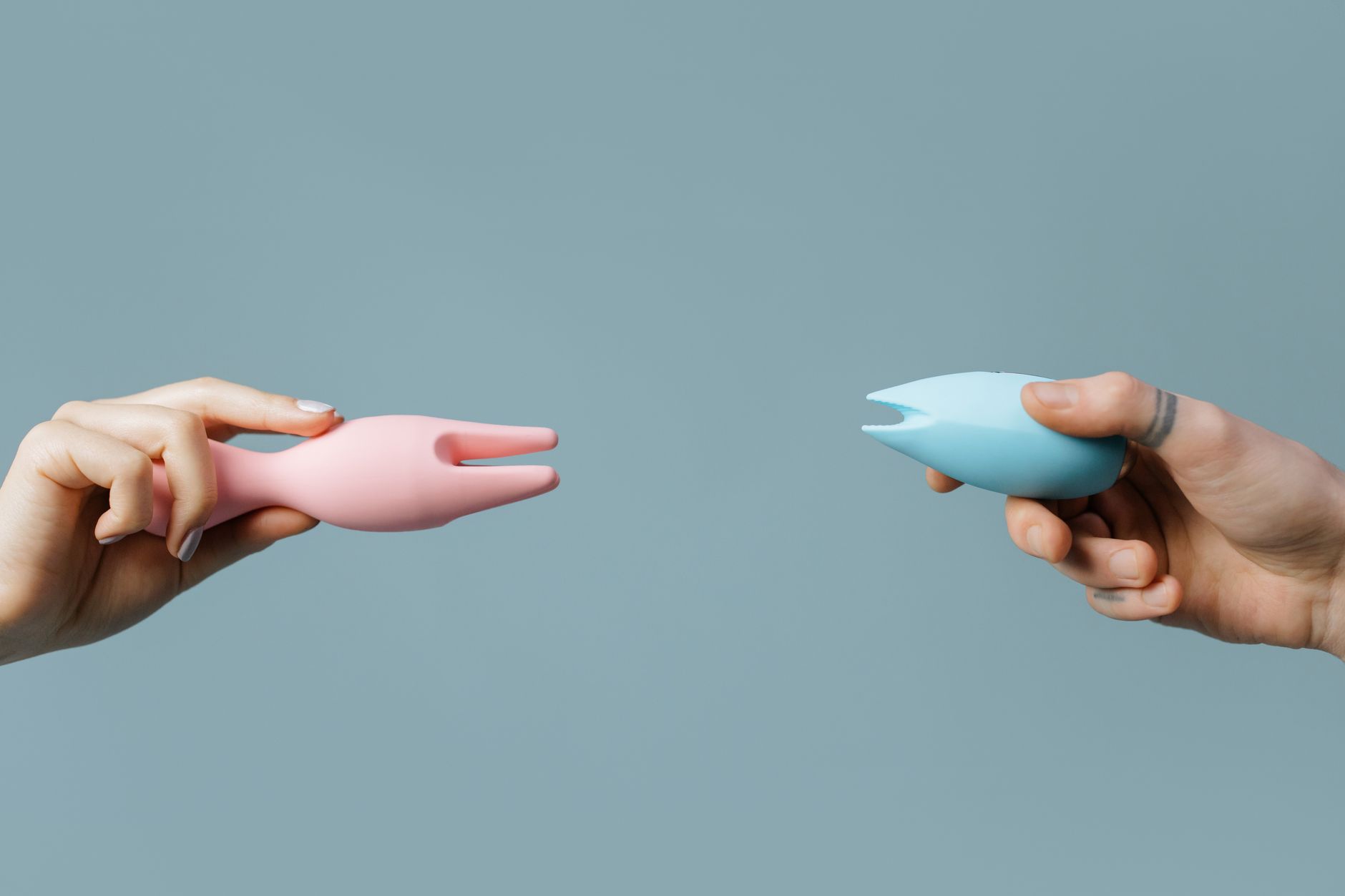
Here's the thing nobody warns you about
Arousal and pleasure aren't the same thing. You can be aroused without feeling pleasure. You can feel pleasure without being aroused. And sometimes your brain and body are in completely different places, having entirely different conversations about what's happening right now. That's not broken. That's actually more common than the alternative.
Most of us learned to think of desire, arousal, and orgasm as a linear path that all happens at once. Step one: get turned on. Step two: get more turned on. Step three: finish. But the reality is messier and more interesting than that. Sometimes your nervous system has checked in. Your body is responsive. Your clitoris is ready. And your brain is still at work, replaying a conversation from yesterday, or thinking about the dishes, or stuck in that loop where you're watching yourself instead of being inside the experience.
That disconnect is what I want to talk about today. Because once you understand why it happens, you can use tools like a lemon clitoral vibrator to help bridge the gap.
Why pleasure and arousal get mismatched
Let's start with the neuroscience because it explains a lot. Arousal happens in the limbic system, which is pretty quick and responsive. It's the ancient part of your brain that reacts to physical stimulation and sexual cues. But pleasure is a different circuit. Pleasure requires something called interoception, which is your brain's ability to feel what's happening in your body. It's the sense of being inside your own skin, paying attention to sensation rather than running through a to-do list.
These two systems don't always fire together. Stress, distraction, depression, and attention disorders can all desynchronize them. So can trauma, even mild stuff you don't think of as a big deal. So can hormonal shifts, medication, or just the accumulated weight of being the person in the relationship who manages everyone's schedule.
When arousal and pleasure diverge, people usually describe it one of two ways. Either "I'm wet but I can't feel anything," which is arousal without pleasure. Or "I want to want this, but my body isn't cooperating," which is pleasure potential without arousal firing.
Here's what matters: both are fixable. And the fix usually involves two things. The first is understanding why the disconnect happened. The second is using the right tools to help your nervous system re-learn the connection. A lemon vibrator works particularly well for this because of how it stimulates the clitoris.
How lemon vibrators help reconnect the two
The clitoris has around 10,000 nerve endings. It's one of the densest pleasure zones on the human body. But those nerves only register as pleasure when your brain is paying attention. When you're dissociated or distracted, even direct stimulation can feel neutral or mechanical.
What a lemon clitoral vibrator does is provide sustained, consistent stimulation that's hard to ignore. Unlike your hand, which gets tired and naturally varies pressure, the vibration pattern of a device like the Lem stays constant. Your nervous system can't tune it out the same way it tunes out a static touch. The sensory input is strong enough that it pulls attention back into the body.
There's also a neurological phenomenon called temporal summation. When stimulation is repetitive, your nervous system gets more sensitized to it over time, not less. That's the opposite of what happens with static touch, where sensitivity decreases. So the vibration pattern in a lemon vibrator actually increases your capacity to feel pleasure the longer you use it.
That said, the tool alone doesn't solve the problem. The way you use it does.
The protocol that actually works
If you're using a lemon vibrator to reconnect arousal and pleasure, here's what I recommend:
Start with no agenda. Not "I need to come." Not even "I need to feel turned on." Just "I'm going to feel what I feel." This sounds obvious until you try it and realize you've spent 20 years conditioning yourself to pursue a specific outcome. Release that. Your only job is attention.
Use the lowest intensity first. Place the Lem on your clitoris at intensity 1 or 2. You're not trying to max it out. You're trying to feel what's there. Spend 3-5 minutes here. Notice the sensation without trying to make it mean anything. Is it warm? Buzzy? Numb? All of the above? The goal is description, not judgment.
Breathe slowly and deliberately. Your vagus nerve, which controls arousal response, is directly connected to your breath. Slow breathing turns on the parasympathetic nervous system, which is where pleasure lives. Fast breathing keeps you in fight-or-flight. If you're using a lemon vibrator and you notice you're holding your breath or breathing shallowly, pause and do 5 slow breaths first. Then resume.
Move gradually up to higher intensities, but only if it feels good. The escalation isn't mandatory. Some people never leave intensity 2 and have incredible experiences. Others want patterns 5 and 6. There's no "right" intensity. The right one is the one where sensation starts to register as pleasure instead of just sensation.
Pay attention to what your mind does. As sensation builds, where does your attention go? Do you drop into your body or does your brain start narrating? If you notice yourself watching the experience from outside, that's the dissociation signal. Pause, ground yourself (feel your feet on the ground, notice the texture of whatever's under you), then resume. You're training your brain to stay present.
Why this matters for partnered sex too
If you're in a relationship and you're experiencing this arousal-pleasure disconnect with a partner, using a lemon vibrator solo first actually helps a lot. Here's why: you're getting your nervous system used to the sensation in a space with zero performance pressure. No one watching. No one's pleasure depending on yours. No subtext about whether this means something about the relationship.
Once you've rebuilt the arousal-pleasure connection on your own, you can bring that skill into partnered situations. The pathway is already there. Your nervous system remembers how to stay present. And if things start to drift again during partnered sex, you know the fix.
That said, if you're with a partner and you want to use a lemon clitoral vibrator together, communication matters way more than technique. Be clear: "I want to try this because it helps me stay present, not because anything's wrong with us." How to use a lemon vibrator when your partner feels threatened by toys digs deeper into that conversation if it's a friction point.
The emotional piece that usually gets skipped
Here's what I see a lot: someone figures out the technique, uses their lemon vibrator correctly, feels pleasure again, and then feels guilty about it. Like they're admitting something was broken. Or they worry that needing a device means something's wrong with their body or their relationship.
Let me be direct: needing help feeling pleasure doesn't mean you're broken. It means you're human and your nervous system occasionally needs support to do what it's supposed to do. We use glasses for eyes, hearing aids for ears. A lemon vibrator is a tool for pleasure reconnection. That's all.
The other thing I notice is that once pleasure and arousal sync back up, people are often surprised by how much desire increases. That's not coincidental. When your nervous system remembers that pleasure is possible, when your brain learns to stay present, you actually want sex more. Not because something magically changed. Because the barrier between wanting it and being able to feel it disappeared.
When to dig deeper
If you're using a lemon vibrator correctly and you're still not feeling pleasure after 2-3 weeks of regular practice, that's a signal to get curious about what else might be happening. Sometimes the disconnect is deeper than attention. It can be rooted in:
Medication side effects, especially SSRIs and some blood pressure drugs. These actually do numb sensation at the nerve level, not just attention-wise.
Unresolved tension in the relationship. Your nervous system might be protecting you from feeling pleasure because some part of you doesn't feel safe.
Trauma. Even stuff that feels small or "handled." Your body sometimes keeps score longer than your mind.
Hormonal shifts. If your arousal-pleasure disconnect started around a medication change or hormonal event, that's worth investigating with a doctor.
This isn't something you need to fix alone. A therapist who understands both neuroscience and sexuality, or a gynecologist who takes pleasure seriously, can help. Your body is trying to tell you something. A lemon vibrator is great for reconnection. But sometimes reconnection requires a conversation with a professional too.
FAQ
Why do I feel aroused but numb at the same time?
Arousal is a physical response mediated by your sympathetic nervous system. Pleasure requires interoception, which is your ability to sense what's happening inside your body. These are two different neural processes. If you're stressed, dissociated, or distracted, arousal can fire while pleasure stays offline. This is more common than you'd think, and a lemon vibrator can help train your nervous system to sync them back up.
How long does it take to reconnect arousal and pleasure?
It varies. Most people notice a shift within 1-2 weeks of consistent practice, though "consistent" means 3-4 times a week minimum. Some people take longer if there's trauma or medication involved. Think of it like physical therapy. The tissue responds, but it takes repetition. Be patient with the timeline.
Can I use my lemon vibrator while I'm on antidepressants?
Yes. SSRIs can numb sensation, but vibration is strong enough that you often still feel it. The technique matters more than the drug. If you're not feeling anything even with a lemon vibrator at higher intensities, talk to your doctor about adjusting your timing or dose. Some people take their SSRI at night instead of morning, which leaves the morning and afternoon with more sensation. Never change your medication without guidance, though.
What if my brain just won't shut up during masturbation?
That's dissociation and it's common. The trick is to interrupt the thought loop before you start. Set a timer for 10 minutes and commit to just sensation. No trying to come. No performance metrics. Just feel. Use anchoring techniques: feel your feet on the ground, notice the temperature of your skin, listen actively to one sound. These all pull your attention back into your body. A lemon vibrator helps because the sensation is strong enough to compete with the thought loop.
Is it normal to need a vibrator to feel anything?
Completely normal. The clitoris has more nerve endings than any other part of your body. It needs strong sensory input to register as pleasure, especially if your nervous system has been in survival mode. A vibrator isn't a crutch. It's a tool. And you can learn to feel pleasure other ways once your nervous system remembers what pleasure actually feels like.
Should I tell my partner I'm using a lemon vibrator for this?
That depends on your relationship. If you're keeping secrets to avoid conflict, that's worth examining. If you're just keeping something private because it's yours, that's fine. The question to ask yourself is: would I want to know? If the answer is yes, tell them. Frame it as "this helps me stay present and it's actually making partnered sex better," because that's the truth. If you need help with that conversation, this post about pleasure feeling one-sided has some language that might work.
The thing to remember
Your body isn't broken. Your arousal and pleasure just got out of sync. And that's fixable. A lemon clitoral vibrator is a good tool for reconnecting them because it provides the kind of consistent, sustained stimulation that pulls your nervous system back into your body. But the real work is showing up, paying attention, and giving your brain permission to feel good without needing to justify it. Do that, and the rest follows naturally.